
If we own or manage a building in New York City, Local Law 97 is no longer an abstract climate rule sitting in the background. It’s a line item in our budgets, and in some cases, a six‑figure risk.
The good news: once we strip away the legal language, Local Law 97 fines actually follow a relatively simple logic. If we know whether our building is covered, how emissions limits work, and how the fine formulas are calculated, we can turn a scary unknown into a manageable planning problem.
In this guide, we’ll walk through Local Law 97 in plain English, who has to pay, how fines are calculated, what timelines matter, and the concrete steps we can take now to avoid penalties while improving our building’s long‑term value.
What Is Local Law 97 And Who Has To Pay Fines?
Local Law 97 (LL97) is the centerpiece of New York City’s Climate Mobilization Act, passed in 2019. Its core idea is simple: large buildings are responsible for most of the city’s greenhouse gas emissions, so they need hard caps on how much carbon they can emit each year.
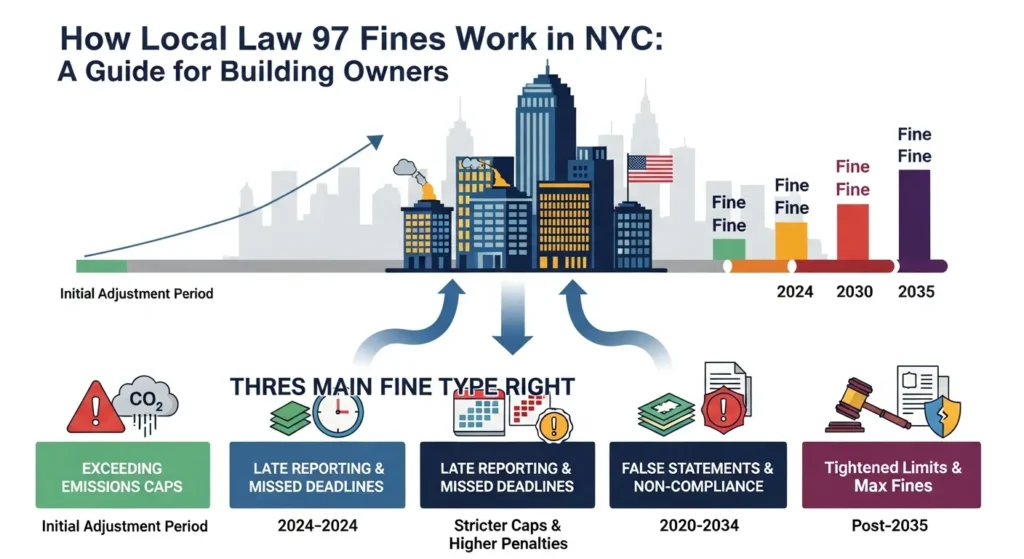
If a covered building’s emissions are higher than its cap, the owner pays a fine. If the owner doesn’t file the required report, there’s another fine. If the owner lies on that report, the penalties are much more severe.
For the official text and rule updates, the city’s Department of Buildings (DOB) maintains a detailed Local Law 97 page here: nyc.gov/site/buildings.
Which Buildings Are Covered Under Local Law 97
Local Law 97 doesn’t apply to every brownstone or three‑family walk‑up. It targets large properties.
We’re generally covered if:
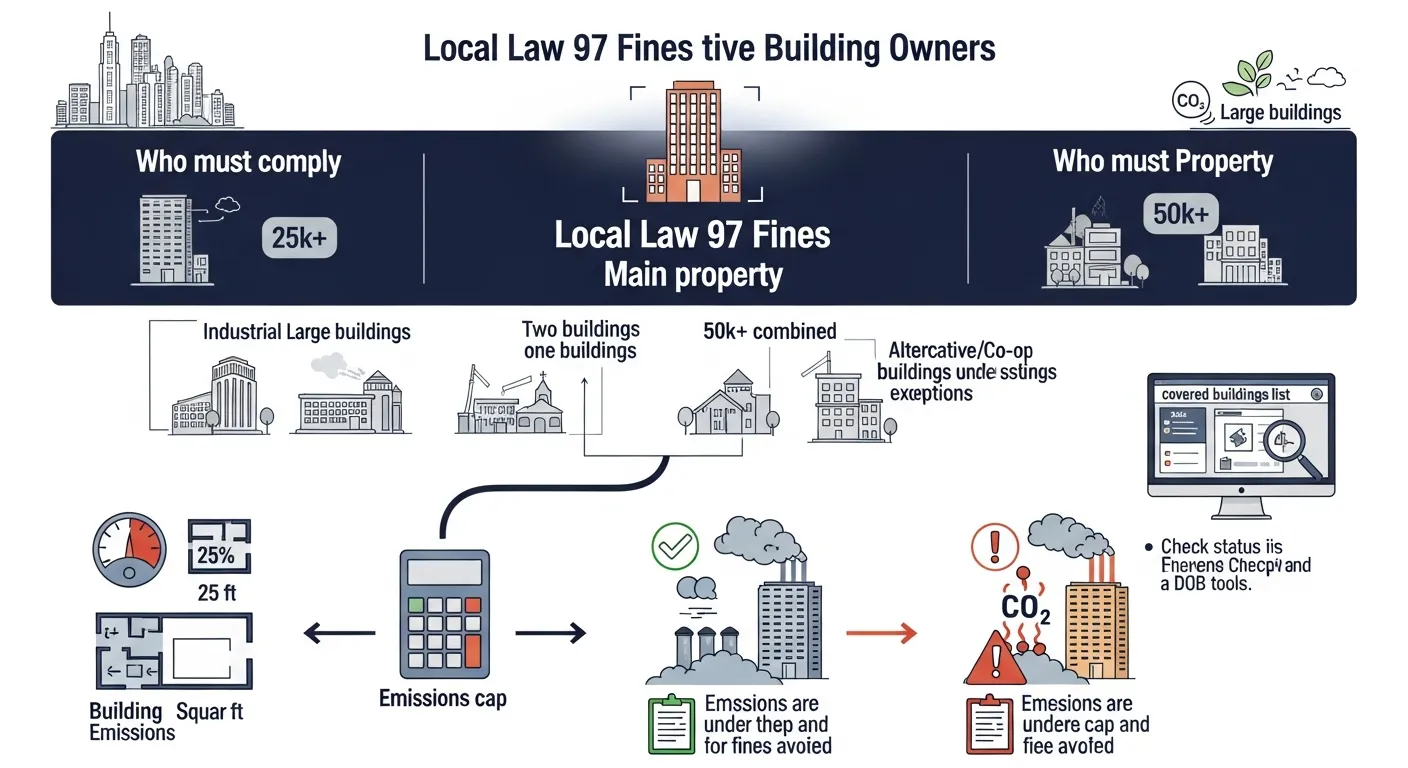
- We own a single building larger than 25,000 gross square feet: or
- We own two or more buildings on the same tax lot with a combined size over 50,000 gross square feet: or
- We’re part of a condo or co‑op association where two or more buildings under the same board total over 50,000 gross square feet.
Some buildings are exempt or have alternative rules. These include certain industrial facilities, houses of worship, and specific types of affordable or rent‑regulated housing that can use prescriptive paths instead of strict emissions caps.
The fastest way to confirm coverage is the DOB Covered Buildings List, available through the DOB website. If we’re already using compliance tools or services like ViolationWatch to monitor NYC building violations, DOB violations, and HPD complaints, it’s smart to keep LL97 status alongside our other NYC property compliance checks.
Key Emissions Limits And Compliance Deadlines
Local Law 97 caps our building’s annual greenhouse gas emissions based on use type (occupancy group) and square footage. Emissions are measured as kilograms of CO₂ equivalent (kg CO₂e) per square foot per year.
Each use type, office, multifamily, hotel, hospital, and so on, has its own emissions limit. These limits tighten over time in phases:
- 2024–2029: First compliance period
- The initial emissions limits apply.
- Many efficient or recently upgraded buildings will meet these caps with limited work.
- Less efficient buildings may already face LL97 fines if they don’t act.
- 2030–2034: Stricter limits
- The caps drop substantially.
- The city has estimated that up to 80% of covered buildings could exceed their 2030 limits if they make no improvements.
- Beyond 2035: Ongoing tightening toward 2050
- Limits continue to move toward the city’s long‑term goal of an 80% emissions reduction by 2050 (and broader carbon neutrality).
- Compliance becomes less about “avoiding fines this year” and more about deep retrofits and electrification.
Our first LL97 emissions report is due May 1, 2025, covering our building’s performance in calendar year 2024. After that, reporting is annual. Even if we’re under the limit, we still have to file the report, the obligation doesn’t go away just because we’re compliant.
How Local Law 97 Fines Are Calculated
Once we know our building is covered, the next question is obvious: what happens if we miss the mark?
LL97 fines fall into three buckets:
- Fines for exceeding the emissions limit.
- Fines for failing to file a report on time.
- Severe penalties for false statements.
The Basic Fine Formula Explained In Plain Language
1. Exceeding the emissions limit
This is the core Local Law 97 fine most of us are thinking about. The formula is:
Annual fine = $268 × (metric tons of CO₂e over the limit)
So we first calculate our allowed emissions based on our building type and floor area. If our actual emissions are higher than the cap, the difference, in metric tons of CO₂e, gets multiplied by $268.
Example:
- Our building’s 2024 cap: 1,000 metric tons CO₂e
- Our actual 2024 emissions: 1,100 metric tons CO₂e
- Excess: 100 metric tons CO₂e
- Fine: 100 × $268 = $26,800 for that year
This repeats every year we’re over the limit, so ignoring the problem quickly adds up.
2. Failing to file a report
Even if we’re under the emissions cap, we can still be fined just for missing paperwork.
The late‑filing penalty is:
$0.50 per square foot, per month the report is late.
Key detail: there’s a grace period. The report is due May 1, but we can file until June 30 without penalty. After June 30, the fine is retroactive to May 1.
Example:
- Building size: 50,000 sq ft
- Report filed on July 15
- DOB counts it as 3 months late (May, June, July)
- Fine = 50,000 × $0.50 × 3 = $75,000
3. False statement on a report
This is where LL97 gets serious.
Submitting a false, misleading, or fraudulent report can trigger:
- Civil penalties up to $500,000, and/or
- Criminal penalties of up to 30 days in jail.
This isn’t a “rounding error” issue: it’s about intentional misrepresentation. The takeaway for us: get the numbers right, have a registered design professional certify them, and keep clean records.
Common Examples Of Fine Calculations By Building Type
Let’s walk through a few simplified scenarios building owners commonly ask about.
Office building – 100,000 sq ft, 50 tons over limit
- Excess emissions: 50 metric tons CO₂e
- Fine: 50 × $268 = $13,400 per year
If that office building stays 50 tons over for five years without improvements, that’s $67,000 in cumulative fines, plus missed energy savings.
Residential co‑op – 75,000 sq ft, 200 tons over limit
- Excess emissions: 200 metric tons CO₂e
- Fine: 200 × $268 = $53,600 per year
For many co‑ops, that’s the size of a major capital project reserve contribution. It’s also the kind of recurring cost that can raise maintenance or common charges.
Missed report – 60,000 sq ft, filed August 1
- Months late (retroactive from May 1): May, June, July, August = 4 months
- Fine: 60,000 × $0.50 × 4 = $120,000
In this case, the building might actually be under its emissions cap, but the administrative miss alone carries a six‑figure hit.
Other Penalties: False Reporting, Missed Filings, And Daily Fines
Owners often ask whether LL97 includes daily fines like some NYC building violations and DOB violations. For Local Law 97 specifically:
- The main late‑filing penalty is monthly, not daily, at $0.50 per sq ft per month.
- Excess emissions fines are assessed annually, based on the prior year’s performance.
- There are no separate “daily” LL97 fines beyond these structures, though DOB can pursue other enforcement actions if we completely ignore the law.
The real “multiplier” effect comes from repeated non‑compliance. If we’re over the emissions cap year after year, or habitually late with reports, we’re signing up for a recurring expense that can easily rival the cost of serious energy upgrades.
Local Law 97 Timeline: When Fines Start And How They Increase
Understanding when LL97 fines actually kick in, and how quickly they get worse, is essential for budgeting.
2024–2029: Initial Compliance Period
The first compliance period covers calendar years 2024–2029. Our first report (for 2024) is due May 1, 2025.
During this phase:
- Emissions caps are more forgiving, especially for newer or already upgraded buildings.
- The city estimates roughly 20% of covered buildings could be above their 2024–2029 limits without action.
- For many owners, this period is effectively a transition window to plan and start work.
Fines for excess 2024 emissions can be assessed after the 2025 report is filed (or missed). That means LL97 penalties are not hypothetical anymore, they’re live.
2030–2034: Stricter Limits And Higher Risk
From 2030, the emissions caps tighten significantly.
- Projections suggest up to 80% of covered buildings may exceed 2030 limits if they do nothing beyond “business as usual.”
- Buildings that were safe in 2024–2029 could suddenly see large fines if they haven’t invested in deeper retrofits.
This is where the math changes. A building barely compliant in 2025 can’t assume it’s safe a decade later. We need to read our energy use intensity (EUI) and long‑term emissions trajectory now and work backward from 2030, not just 2024.
Beyond 2035: Long-Term Expectations
After 2035, Local Law 97’s role is to keep pushing NYC’s building stock toward net‑zero‑aligned performance.
We should plan for:
- Ongoing tightening of limits roughly in line with the city’s 2050 climate goals.
- Higher expectations around electrification (switching from fossil‑fuel boilers to heat pumps and other electric systems).
- More scrutiny on envelope performance (insulation, windows, air sealing) and peak demand.
From a financial standpoint, this means LL97 isn’t a one‑time hurdle. It’s more like a moving target that forces us to think 10–20 years out when we replace boilers, roofs, or major HVAC equipment.
How To Tell If Your Building Is At Risk For Local Law 97 Fines
Before we panic about LL97 fines, we should diagnose our risk. That starts with some basic data we already have, or can easily pull from city sources.
Key Data You Need: Size, Use, And Current Emissions
At minimum, we should know:
- Gross floor area (GFA) in square feet.
- Occupancy/use types – office, multifamily, hotel, mixed‑use, etc.
- Primary fuel sources – gas, oil, electric, steam.
- Annual energy use – from utility bills (kWh, therms, gallons, steam lbs, etc.).
We then convert energy use into annual emissions (metric tons CO₂e). Tools like the NYC Accelerator’s Building Energy Snapshot and standard benchmarking software can help with these calculations.
If we’re already used to tracking NYC building violations or HPD complaints via tools like the NYC violation lookup tool, adding an emissions snapshot to our regular reviews is a logical next step.
Reading Your Benchmarking Reports And Energy Use Intensity
Our Local Law 84 (LL84) Benchmarking reports are invaluable here. They show:
- Energy Use Intensity (EUI) – usually in kBtu/sq ft/year.
- ENERGY STAR scores where applicable.
- A breakdown of fuel types and end uses.
We can compare these with LL97 emissions limits to see how close we are to the cap. The city’s official benchmarking portal and HPD’s online building data tools (HPD Online) make it easier to cross‑check our information.
In practice:
- A building with very high EUI (especially from gas or oil heating) is more likely to exceed LL97 limits.
- Efficient, recently upgraded buildings with moderate EUI are often safe for the first period but might be at risk by 2030 if nothing more is done.
Red Flags That Suggest High Fine Exposure
Some warning signs we’re likely to pay Local Law 97 fines unless we act:
- Old, oversized, or poorly tuned boilers, especially oil‑fired.
- No recent lighting upgrades – still using T12s or older CFLs instead of LEDs.
- Little or no submetering, so we don’t know which tenants or systems drive peaks.
- Comfort complaints (too hot, too cold) that lead staff to run systems longer than necessary.
- No energy audit or retro‑commissioning in the past decade.
- Benchmarking scores consistently below peers, especially in the same occupancy type.
If we see two or three of these, it’s worth assuming we’re at real risk of LL97 penalties and building a plan accordingly.
Legal Options To Reduce Or Delay Local Law 97 Fines
Local Law 97 is strict, but it isn’t totally inflexible. The law recognizes that some owners face genuine constraints, structural, legal, or financial, and offers a few safety valves.
Good Faith Efforts And Adjustment Applications
The DOB can consider “good faith efforts” when assessing penalties, particularly in the early years. In practice, that means:
- Documented decarbonization plans or studies.
- Filed permits and contracts for energy upgrades.
- Evidence that we’re making our building “electric‑ready” (e.g., electrical service upgrades).
There are also formal adjustment applications for buildings that can’t reasonably meet their limits due to:
- Structural conditions (e.g., landmarked façades that complicate envelope work).
- Legal constraints (e.g., restrictions on altering certain spaces).
- Other technical barriers.
These applications are not rubber‑stamped. They typically require:
- A decarbonization study prepared by qualified professionals.
- A clear timeline of planned work.
- Proof that we’re doing what’s reasonably possible within our constraints.
Hardship, Financial Constraints, And Special Cases
The law also accounts for buildings that serve vulnerable populations or operate under tight statutory rules, such as:
- Properties with rent‑regulated units.
- Certain types of affordable housing.
- Some buildings with heavy public or institutional functions.
For these, there may be:
- Two‑year grace periods.
- Alternative compliance paths, where we follow prescriptive upgrade measures instead of meeting a strict emissions cap.
To navigate this, we should consult both the DOB LL97 guidance and, when necessary, qualified counsel who understands NYC property compliance.
What Happens If You Ignore Local Law 97
Ignoring LL97 is not a viable long‑term strategy.
If we look the other way:
- DOB can issue fines for excess emissions and missed reports, year after year.
- Late‑filing penalties can turn a simple oversight into a major budget hit.
- Persistent non‑compliance can eventually lead to liens, enforcement actions, and reputational damage.
And if we submit false information, we’re opening the door to criminal penalties plus to civil fines.
Given how visible NYC building violations, DOB violations, and HPD complaints are in public databases, and on tools like ViolationWatch and city open data portals, repeated LL97 problems can also affect how lenders, buyers, and tenants view our property.
Practical Strategies To Cut Emissions And Avoid Fines
Once we understand the risk, the next step is practical: what can we actually do to cut emissions, ideally in ways that pay back over time?
Low-Cost Operational Changes You Can Make Now
Some of the fastest emission reductions don’t require huge capital projects. They require paying attention to how we run the building.
Practical low‑ or no‑cost moves:
- Optimize boiler and chiller schedules – avoid running systems hours before or after they’re needed.
- Carry out night and weekend setbacks for temperatures, within comfort guidelines.
- Balance and tune controls so we aren’t overheating some zones while others freeze.
- Upgrade lighting to LED, targeting common areas, garages, and back‑of‑house first.
- Use occupancy sensors and timers for stairwells, storage rooms, and restrooms.
- Start tenant engagement campaigns, simple messaging about windows, space heaters, and after‑hours usage adds up.
These moves may not get a very inefficient building under the LL97 cap on their own, but they reduce the gap, and hence shrink potential fines.
Capital Projects With Big Impact On Emissions
To future‑proof against LL97, especially after 2030, we’ll eventually need deeper projects. Typical high‑impact strategies include:
- Boiler replacement and electrification
- Swapping old gas or oil boilers for air‑source or ground‑source heat pumps where feasible.
- Moving toward electric‑ready configurations when full electrification isn’t immediate.
- Envelope improvements
- Better insulation, air sealing, and higher‑performance windows.
- Roof replacements that add insulation and cool roof or solar‑ready surfaces.
- HVAC and controls upgrades
- Modern building management systems (BMS) that optimize schedules and setpoints.
- Variable speed drives (VFDs) on pumps and fans.
- Zoning improvements to match heating and cooling to actual occupancy.
- On‑site renewables
- Solar PV where roofs or adjacent structures allow it.
- Coordinated strategies with battery storage in some buildings.
For many owners, a combination of lighting, controls, and more efficient heating equipment can substantially narrow or eliminate LL97 fines, and generate meaningful energy savings.
Working With Engineers, Energy Auditors, And Contractors
Local Law 97 is technical by design. We don’t need to become energy engineers, but we do need the right professionals on our side.
Helpful partners typically include:
- Energy auditors who can benchmark our building, identify cost‑effective measures, and estimate LL97 impacts.
- Mechanical and electrical engineers experienced with NYC codes, DOB filings, and decarbonization.
- Contractors who’ve delivered LL97‑related projects, not just generic boiler swaps.
The city’s NYC Accelerator program offers free advisory support and tools to help owners understand their options and connect with vetted vendors. Combined with regular monitoring of DOB violations, HPD issues, and LL97 status, potentially using services such as building violation alerts, we can stay ahead of problems instead of reacting to them late.
Budgeting And Financing For Compliance
The question most boards and owners ask after seeing the LL97 math is: how do we pay for this?
The answer is part risk management, part investment planning.
Estimating Costs Versus Potential Fines
We should start by modeling two numbers side by side:
- Projected annual fines if we don’t act (or act lightly).
- Capital and operating costs of efficiency and electrification projects.
If excess emissions would cost us $50,000–$150,000 per year in Local Law 97 fines, a project that costs $500,000 but saves $75,000 per year in combined energy costs and avoided penalties suddenly looks very reasonable, especially over a 10–15 year timeline.
We should also factor in:
- Reduced exposure to energy price volatility.
- Potential boosts in asset value and loan terms for more efficient buildings.
- The reputational risk of being known as a chronic LL97 violator, visible in public data and on tools like the NYC violation lookup tool.
Available Incentives, Rebates, And Financing Tools
NYC and New York State have leaned heavily on incentives to make this easier. Depending on our building type, we may be able to tap:
- NYSERDA programs – such as multifamily efficiency programs, Clean Heat incentives for electrification, and studies that subsidize engineering analysis.
- Utility rebates – from Con Edison and others, for lighting, HVAC upgrades, and heat pumps.
- PACE financing (Property Assessed Clean Energy) – long‑term financing repaid through property tax bills, often matching the useful life of improvements.
- Green banks and specialized lenders – who are increasingly familiar with LL97‑driven projects.
Many of these options are updated frequently, so we should rely on current information from official sources like NYSERDA and utility websites, along with advisors who track these programs full‑time.
Planning A Multi-Year Compliance Roadmap
Instead of one huge decision, we’re really building a multi‑year roadmap that might look like this:
- Year 1–2
- Confirm coverage using the DOB Covered Buildings List.
- Commission an energy audit and LL97 compliance study.
- Carry out low‑cost operational changes and LED lighting upgrades.
- Apply for relevant incentives.
- Year 3–5
- Schedule major equipment replacements (boilers, chillers, controls) with LL97 in mind rather than like‑for‑like swaps.
- Address the worst‑performing systems and high‑leverage envelope projects.
- Year 6–10
- Move toward partial or full electrification where feasible.
- Evaluate on‑site renewables and storage if the site supports them.
- Re‑benchmark emissions after each major project and adjust the plan.
Throughout, we should track NYC property compliance holistically, not just LL97, but also DOB violations, HPD complaints, and other NYC building violations, since enforcement actions often overlap and stress the same budgets.
Documentation, Reporting, And Staying Organized
One of the easiest ways to trigger Local Law 97 fines is simply bad paperwork. Good systems protect us.
Required Annual Filings And Deadlines
LL97 doesn’t exist in a vacuum. It sits alongside other NYC energy laws:
- Local Law 97 Emissions Report
- Due May 1 each year (first due May 1, 2025 for 2024 data).
- Must be certified by a registered design professional.
- Local Law 84 (Benchmarking) Report
- Also due May 1 annually.
- Uses utility data to measure EUI and emissions.
- Local Law 88 (Lighting & Submetering)
- Requires upgraded lighting and submetering in many buildings.
- Deadlines have intersected with LL97 extensions in some cases.
Missing any of these can generate separate DOB violations and fines, on top of any LL97 exposure.
What To Keep On File To Protect Yourself In An Audit
If DOB reviews our LL97 reports, well‑organized documentation can be the difference between a routine check and a drawn‑out investigation.
We should maintain:
- Utility bills and interval data for at least several years.
- Benchmarking submissions (LL84) and confirmation emails.
- The LL97 emissions reports and calculations.
- Decarbonization studies, energy audits, and engineering models.
- Contracts, permits, and invoices for energy projects.
- Any adjustment or hardship applications, plus DOB responses.
Storing all of this centrally, not scattered across personal email accounts, is critical, especially for co‑ops and condos where board membership turns over.
Working With Your Management Team And Boards
Finally, LL97 is a governance issue, not just an engineering one.
For co‑ops, condos, and multi‑owner buildings, we should:
- Ensure boards and shareholders understand the basics of Local Law 97 fines and timelines.
- Build LL97 costs and upgrades into capital plans and reserve studies.
- Assign a point person or committee responsible for NYC property compliance, including DOB and HPD filings, NYC building violations, and LL97 reports.
- Use simple reporting dashboards, whether internal spreadsheets or external services such as ViolationWatch, to track open issues and deadlines.
If we prefer a more automated approach, we can get instant alerts whenever our building receives a new violation, sign up for real-time monitoring with building violation alerts so DOB violations and HPD complaints don’t slip through the cracks while we’re focused on LL97 projects.
Conclusion
Local Law 97 marks a turning point for NYC building owners. It converts the city’s climate goals into hard numbers, annual emissions limits, per‑ton fines, and clear reporting deadlines.
If we ignore it, LL97 becomes a recurring tax on inefficiency. If we engage with it early, it becomes a framework for smarter capital planning, better buildings, and in many cases, long‑term savings.
Next Steps For Owners To Stay Ahead Of Local Law 97 Fines
To stay in front of the fines instead of chasing them, we can:
- Confirm coverage – Use the DOB Covered Buildings List to see if our property is subject to LL97.
- Pull our LL84 benchmarking data – Review current EUI and emissions, then compare to LL97 limits for our occupancy type.
- Estimate our fine exposure – Run simple scenarios: what happens if we’re 50, 100, or 200 tons over the cap?
- Carry out quick wins – Tune schedules, upgrade lighting, address obvious inefficiencies now.
- Develop a multi‑year retrofit roadmap – Align boiler replacements, HVAC upgrades, and envelope work with 2030 and 2035 limits.
- Leverage incentives and financing – Tap NYSERDA, utility programs, and PACE to reduce out‑of‑pocket costs.
- Organize reporting and monitoring – Keep our LL97, DOB, and HPD documentation current and centralized.
Alongside LL97, it’s smart to keep an eye on other NYC building violations and enforcement that can affect our risk profile. For free lookups, use our NYC violation lookup tool to see what’s already on record for our property, and consider ongoing building violation alerts so nothing important arrives unnoticed.
Local Law 97 isn’t going away, but we don’t have to treat it as a constant threat. With clear information, a realistic plan, and the right partners, we can turn compliance from a source of anxiety into another way we protect, and improve, our buildings.
Key Takeaways
- Local Law 97 fines apply to most NYC buildings over 25,000 square feet (or grouped properties over 50,000 square feet), based on how far their annual emissions exceed a use‑type‑specific carbon cap.
- The main Local Law 97 fine for emissions is calculated as $268 multiplied by each metric ton of CO₂e over the limit, creating recurring annual costs if owners delay upgrades.
- Owners face additional penalties of $0.50 per square foot per month for late emissions reports, plus severe civil and potential criminal penalties for false or fraudulent filings.
- Fine exposure rises sharply after 2030 as emissions limits tighten, so owners should use current LL84 benchmarking data and energy use intensity to model their Local Law 97 fines risk now.
- Practical compliance starts with low‑cost operational tweaks, then progresses to planned capital projects such as boiler electrification, envelope upgrades, and modern controls aligned with 2030–2035 targets.
- A multi‑year roadmap that leverages incentives, financing, and good documentation—while tracking LL97, DOB, and HPD requirements together—turns Local Law 97 from a surprise liability into a manageable long‑term investment.
Frequently Asked Questions About Local Law 97 Fines
What are Local Law 97 fines and when do they start for NYC buildings?
Local Law 97 fines are penalties New York City building owners pay if their covered buildings emit more greenhouse gases than allowed or if they miss required emissions reports. Fines based on 2024 performance can be assessed after the first report is due on May 1, 2025, and continue annually.
How are Local Law 97 fines calculated if my building exceeds its emissions limit?
If your building’s annual emissions are above its Local Law 97 cap, the core fine is calculated as: $268 multiplied by each metric ton of CO₂e over the limit. This charge applies per year, so staying above the cap for multiple years can create a large, recurring financial burden.
Can I be fined under Local Law 97 even if my building is under the emissions cap?
Yes. You can face Local Law 97 fines for failing to file the required annual emissions report on time, even if your building is under its emissions limit. The late‑filing penalty is $0.50 per square foot per month after June 30, retroactive to May 1, until your report is submitted.
What is the best way to tell if my building is at risk for Local Law 97 fines?
Start by confirming your building is covered using the DOB Covered Buildings List. Then review your floor area, occupancy type, fuel sources, and annual energy use. Compare your current emissions and Energy Use Intensity (from LL84 benchmarking) to LL97 limits to see how far you are from the cap.
Can Local Law 97 fines be reduced or delayed if upgrades are difficult or expensive?
In some cases, yes. The Department of Buildings can consider good‑faith efforts and offers adjustment and hardship applications. Strong documentation—decarbonization studies, planned or permitted upgrades, and proof of constraints—may help reduce or delay penalties, especially for buildings with structural, legal, or affordability limits.
What practical steps should owners take now to avoid future Local Law 97 fines?
Owners should implement low‑cost operational changes, such as optimizing boiler schedules and upgrading to LED lighting, while planning larger capital projects like boiler replacements, electrification, and envelope improvements. At the same time, build a multi‑year retrofit roadmap, apply for incentives, and keep LL97 and benchmarking reports organized and timely.