
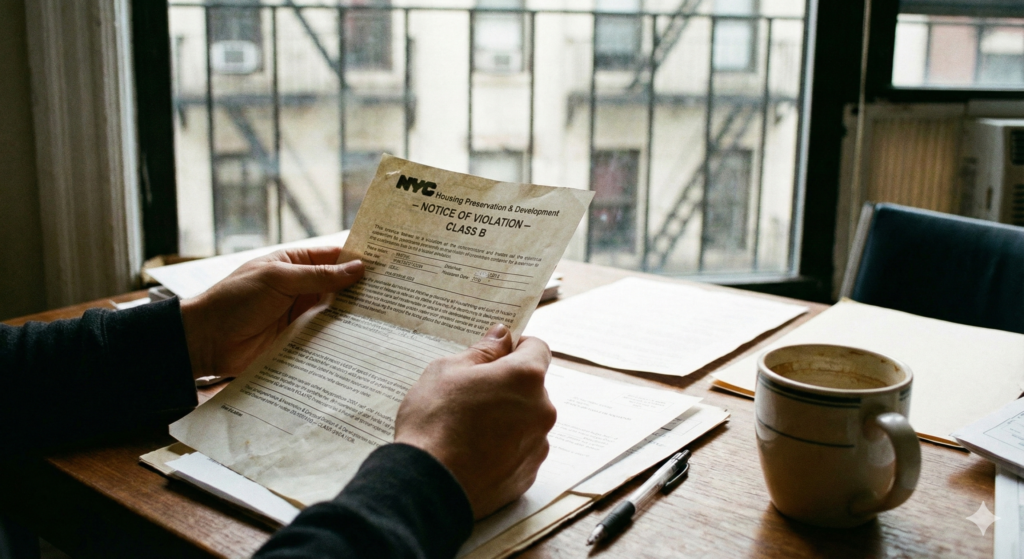
The clock starts ticking the moment a Class B housing violation hits your building in New York City. In most cases, we’ve got 30 days to fix the condition, certify the correction, and avoid escalating fines or a Housing Court case.
In this guide, we walk through how Class B violations work, how to read exactly what HPD (and sometimes DOB) is citing, and what we actually need to do, step by step, to clear the violation and keep it from coming back. We’ll also look at the legal and financial fallout of ignoring NYC building violations, and how to set up systems so we’re not constantly putting out fires.
This isn’t theory. These are the practical steps owners, managers, and boards use every day to stay on top of NYC property compliance and keep HPD complaints from turning into long‑term problems.
Understanding Class B Housing Violations In NYC
How NYC Classifies Housing Violations
New York City’s Housing Maintenance Code groups violations into three main classes, based on how dangerous the condition is:
- Class A – Non‑hazardous: Quality‑of‑life issues that still matter but aren’t considered dangerous. Think minor repairs or cosmetic issues. Owners usually get 90 days to correct these.
- Class B – Hazardous: This is our focus here. These are hazardous conditions that affect health or safety but aren’t immediately life‑threatening. The standard correction period is 30 days from the date of service of the notice.
- Class C – Immediately hazardous: Serious issues, no heat in winter, major leaks causing collapse risk, serious lead hazards, etc. Correction deadlines can be as short as 24 hours and up to about 21 days, depending on the issue.
The NYC Department of Housing Preservation and Development (HPD) classifies violations under this system, and the class is clearly listed on the notice and on HPD’s online records. HPD explains the framework and enforcement powers on its official violations overview.
Examples Of Common Class B Violations
Class B violations cover a wide mix of “hazardous but not immediately life‑threatening” conditions. Some typical HPD Class B violations we see again and again include:
- Pest infestations – roaches, mice, rats, or other vermin in apartments or common areas.
- Mold and moisture – visible mold in a bathroom, bedroom, or hallway: chronic damp walls or ceilings that haven’t reached structural failure.
- Some heat and hot‑water issues – for example, hot water present but not at the required temperature, or inconsistent heat that doesn’t rise to a Class C emergency.
- Broken or defective windows and doors – damaged locks, rotted sashes, or doors that don’t close properly but aren’t yet a security or fire egress emergency.
- Ventilation problems – inoperable bathroom or kitchen exhaust fans where required, blocked vents, or sealed grills.
- Lighting and electrical issues – missing light fixtures in common areas, exposed but non‑immediately dangerous wiring.
The exact description for each violation appears in the HPD database by code and short text. For NYC building violations, getting familiar with those codes helps us quickly understand what HPD expects to see fixed.
Time Frames, Fines, And Penalties For Class B Violations
For most Class B violations issued by HPD:
- Correction deadline: Typically 30 days from the date the Notice of Violation/Order to Correct is served.
- Civil penalties for violations issued on or after December 8, 2023: A base penalty in the range of $75–$500 per violation, plus daily penalties of about $25–$125 per day until the condition is corrected and certified.
- Housing Court risk: If we don’t correct and certify, HPD can bring a case in Housing Court to seek penalties and a court order.
- Liens and long‑term impact: Unpaid penalties can become liens on the property, which will show up in due diligence for sales, refinancing, or insurance.
HPD and the courts take repeat and chronic conditions seriously. A pattern of open Class B violations, especially combined with HPD complaints about similar issues, can push a building onto HPD’s radar for more aggressive enforcement programs.
Finding Out Exactly What Your Class B Violation Is
Before we send anyone with a toolbox, we need to know exactly what HPD (or the Department of Buildings, DOB) says is wrong and what code section applies.
How To Look Up Violations Online (HPD And DOB Systems)
For HPD violations and HPD complaints:
- Go to HPDONLINE, which HPD links from its HPD Online portal page.
- Search by building address or borough/block/lot (BBL).
- The system will show:
- All open and closed violations, with Class (A/B/C) clearly listed.
- The violation number, code, short description, and the date issued.
- Status (open, certified, closed after inspection, etc.).
For DOB violations (which can overlap if HPD’s issue involves structural, gas, or major electrical work):
- Use DOB BIS or DOB NOW public portals on the NYC Department of Buildings site: https://www.nyc.gov/site/buildings/index.page.
- Search by address or BIN (Building Identification Number).
- Look for violations, ECB/OATH summonses, and notices of violation.
If we want everything in one place, tools like ViolationWatch can help us monitor and track open HPD and DOB violations across a portfolio. For free lookups, use our NYC violation lookup tool to quickly see where we stand.
Reading The Violation Notice And Order To Correct
The Notice of Violation/Order to Correct is our roadmap. It tells us:
- Violation class: A, B, or C.
- Specific description: The condition HPD observed (e.g., “MOLD PRESENT ON WALL IN BATHROOM” or “ROACH INFESTATION THROUGHOUT KITCHEN”).
- Location: Apartment number, floor, or common area.
- Responsible party: Usually the owner and managing agent are named.
- Deadline to correct and certify: The date by which HPD expects the work to be completed.
- Instructions for certification: How and where to submit the Certification of Correction (online, mail, or in person).
If the language is vague, we shouldn’t guess. It’s often worth calling HPD or reviewing the violation code details on their site to be sure we’re addressing the right condition.
Confirming Responsibility: Owner, Managing Agent, Or Tenant
By default, HPD places responsibility on the owner (and any registered managing agent) to keep the building code‑compliant, even if a tenant contributed to the condition.
But, in practice there are three buckets of responsibility:
- Owner/management responsibility
- Building systems: heat, hot water, plumbing lines, electrical risers, roofs, windows.
- Common areas: hallways, stairwells, basements, lobbies.
- Conditions in apartments that arise from building systems (e.g., leaks causing mold).
- Tenant‑caused conditions
- Hoarding that attracts pests.
- Tenant‑installed locks or gates that violate egress rules.
- Refusal of access that prevents repair.
- Shared responsibility
- For example, a tenant’s clutter hides a leak, but the leak is from a building pipe.
In Housing Court, owners sometimes raise tenant‑caused or access‑denial defenses, but we can’t assume HPD will simply drop the violation. We still need to document written access requests, attempted appointments, and any proof that the condition arose from a tenant’s actions.
Planning The Correction: Safety, Scope, And Budget
Once we know the exact violation, we plan the fix. The biggest mistakes we see are either under‑scoping (doing a quick cosmetic clean‑up) or over‑scoping (over‑engineering minor repairs and losing the 30‑day window).
Determining What Work Is Required To Comply With The Code
We start by matching the HPD violation code with the Housing Maintenance Code requirement. HPD’s code tables and descriptions, available through HPDONLINE and HPD’s website, tell us what the inspector expects.
For example:
- A mold violation for a small bathroom might only require cleaning, treating, and repainting with a mildew‑resistant coating, plus fixing the underlying leak or ventilation issue.
- A pest violation might require sealing holes, installing door sweeps, cleaning refuse areas, and hiring a licensed exterminator for a treatment plan.
- A ventilation violation can be as simple as restoring power to a fan or repairing a broken exhaust fan where mechanical ventilation is required.
We should always evaluate the root cause, not only the visible symptom. If mold is caused by a leaking line behind the wall, HPD will look for that leak to be addressed, not just painted over.
When You Need Licensed Contractors Or Design Professionals
Not every Class B violation is a handyman job. Some corrections cross into DOB territory and require:
- Licensed plumbers or gas fitters – for gas piping, riser repairs, and many boiler‑related issues.
- Licensed electricians – for new circuits, service upgrades, or correcting unsafe wiring that triggered DOB violations.
- Registered design professionals (PE/RA) – when structural work, major reconfiguration, or substantial building‑system modifications are needed.
DOB “Class B” violations, which are separate from HPD’s classification, often carry penalties in the $2,500–$10,000 range and can’t be resolved without proper permitting and sign‑offs. When in doubt, we check DOB’s records, or speak to a professional about whether a DOB permit is needed before we touch anything.
Coordinating Access With Tenants And Scheduling Work
Even the best repair plan fails if we can’t get into the apartment.
We should:
- Contact the tenant quickly – ideally within a few days of receiving the violation.
- Offer multiple appointment windows, including evenings or weekends if possible.
- Confirm in writing, by email, text, or letter, so we have proof of notice.
If a tenant repeatedly refuses access, we document:
- Dates and times of attempted access.
- Notices posted or mailed.
- Any emails or texts where we offered alternative times.
This documentation becomes critical if the violation ends up in Housing Court. Even then, HPD expects us to be proactive, ignoring the problem because “the tenant didn’t pick up the phone” almost always backfires.
Fixing The Problem: Step-By-Step For Common Class B Issues
Class B conditions often fall into a few predictable categories. Here’s how we typically approach the most common ones.
Heat, Hot Water, And Plumbing-Related Violations
When HPD calls out heat or hot water but classifies it as Class B, the issue is usually one of temperature, consistency, or distribution rather than a total outage.
Steps we can take:
- Check boiler and controls
- Confirm the boiler is functioning and sized correctly.
- Review timers, aquastats, and outdoor reset controls.
- Verify temperatures
- Use a thermometer at the tap for hot‑water issues.
- Check apartment temperatures at different times of day.
- Bleed or balance the system
- Bleed radiators.
- Adjust valves and balance lines so end‑of‑line units get heat.
- Address leaks and clogs
- Fix dripping fixtures, running toilets, or clogged waste lines that contribute to mold or pest conditions.
We document all work with dates, photos, and invoices so we can comfortably certify that the condition is corrected.
Electrical, Lighting, And Ventilation Violations
For electrical and lighting Class B violations:
- Inspect fixtures, switches, and junction boxes to ensure there are no exposed live parts.
- Replace broken fixtures in hallways and stairwells promptly.
- If anything suggests unsafe wiring beyond a simple fixture swap, we bring in a licensed electrician.
For ventilation violations:
- Confirm bathroom and kitchen fans are operational where building code requires them.
- Clear blocked vents and grills.
- Restore or replace broken fans: verify that venting ductwork is intact and not terminated improperly.
HPD inspectors will often turn fans on during reinspection: they don’t just look at the grill.
Doors, Windows, Mold, And Pest Conditions
Doors and windows
- Repair or replace broken locks to ensure doors are secure.
- Make sure entrance doors close and latch on their own.
- Replace cracked or dangerously loose glass.
- Address frame rot or hardware failures that affect safety.
Mold and moisture
- Identify and fix the source of moisture (leaks, condensation, poor ventilation).
- Remove damaged materials where necessary.
- Clean affected areas with appropriate antimicrobial methods.
- Repaint using mildew‑resistant coatings.
Pests (roaches, mice, rats, bedbugs)
- Hire a licensed exterminator for an integrated plan.
- Seal entry points, gaps around pipes, under doors, at baseboards.
- Improve trash storage: covered cans, more frequent removal, clean compactor areas.
- Educate tenants on food storage and clutter.
Because HPD ties many pest violations to building conditions (open holes, trash, leaks), we focus on both extermination and physical repairs.
Fire Safety, Carbon Monoxide, And Smoke Detector Issues
Even when not classified as Class C, smoke and carbon monoxide detector issues are taken seriously.
We should:
- Install or replace required smoke and CO detectors in each unit and common area, following NYC code on placement.
- Provide written instructions and, where required, affidavits of installation or notices to tenants.
- Make sure detectors are hard‑wired or battery‑operated as permitted, and that combined units meet the latest standards.
For other fire‑safety Class B violations (blocked egress paths, self‑closing doors that don’t latch, exit signs not illuminated), we:
- Clear hallways and stairs of stored items.
- Adjust, repair, or replace self‑closing hardware on doors.
- Fix or replace exit signs and emergency lighting.
These are exactly the types of conditions HPD and DOB recheck, and they become big problems if they appear repeatedly in NYC building violations histories.
Paperwork And Permits: What You Need Before You Certify
Fixing the condition is only half the job. The other half is proving it, both to HPD and, when necessary, to DOB.
When A DOB Permit Is Required Versus Simple Repairs
As a rule of thumb:
- Simple repairs (like repainting, patching plaster, replacing a light fixture with a similar one, or swapping a faucet) typically do not require DOB permits.
- Work on gas lines, structural elements, major electrical changes, or system alterations usually does require permits and inspections.
If HPD’s Class B violation leads us to discover a larger defect, for example, an overloaded electrical panel or defective gas riser, that triggers DOB involvement. At that point, we’re dealing with DOB violations and must follow DOB’s permitting and sign‑off process before certifying everything as resolved.
When we’re not sure, we check DOB’s guidance or consult with a licensed professional rather than risk an unpermitted alteration.
Collecting Proof: Invoices, Photos, And Contractor Certifications
For each violation, we build a simple file (digital is fine) with:
- Before and after photos – clearly showing the condition and the correction.
- Invoices and work orders – from contractors or building staff.
- Licenses and certifications – proof that any plumber, electrician, or exterminator is properly licensed.
- Test results or readings – for heat/hot water temperatures, CO detector tests, etc.
This documentation serves three purposes:
- It supports our Certification of Correction with HPD.
- It protects us if HPD reinspects and disputes the correction.
- It helps in Housing Court if HPD or tenants claim we didn’t do enough.
Dealing With Lead Paint, Gas Work, And Other Special Cases
Some issues sit in a higher‑risk category even when classified as Class B:
- Lead‑based paint – Work disturbing paint in apartments where a child under 6 resides is heavily regulated. We may need certified lead‑safe work practices, clearance dust wipes, and specific documentation under NYC’s Local Law 1.
- Gas work – Virtually all gas piping work must be performed by a licensed master plumber with DOB permits. Self‑help here is a non‑starter.
- Elevators, boilers, and other regulated equipment – These often involve other NYC agencies and third‑party inspectors.
When we’re in these gray areas, we budget additional time and cost, and assume HPD and DOB will look more closely at our paperwork.
How To Certify A Class B Violation As Corrected
We don’t want to do the work and then forget to tell HPD. An un‑certified violation is an open violation, even if the condition is fixed.
Using The HPD Online Portal To Submit Certification
Most owners now certify Class B violations through HPDONLINE.
Steps generally look like this:
- Log into the HPD online portal using the registered owner or managing agent credentials.
- Locate the specific violation number from the building’s violation list.
- Complete the Certification of Correction form, attesting that the condition has been corrected as of a certain date.
- Upload or retain supporting documents, depending on HPD’s instructions.
- Submit and keep a copy or screenshot of the confirmation for our records.
If there are multiple violations in the same apartment, we confirm each one individually. HPD treats each violation as its own item for penalty purposes.
Mail-In And In-Person Certification Options
HPD still allows mail‑in or sometimes in‑person certifications:
- The back of the violation notice usually includes a paper certification form or instructions.
- We fill it out completely, sign it, and send it to HPD at the listed address, ideally by a trackable mail method.
- For in‑person options (less common now), we bring the completed form and any supporting documents.
Mail‑in certifications carry a real risk: if they arrive late or incomplete, HPD may reject them and penalties can start accruing. Online submissions give us immediate confirmation and a clearer record.
Preparing For Possible Reinspection And What Inspectors Look For
HPD isn’t required to reinspect every certified violation, but for many Class B conditions they do.
Inspectors typically check:
- Is the cited condition truly corrected? Not just painted over, but fixed at the source.
- Are related hazards also addressed? For example, if mold was cited, is the leak fixed and the moisture under control?
- Have we created new violations? An incomplete repair or a shortcut can trigger a new Class B or even Class C violation.
We prepare by:
- Double‑checking the apartment or area right before the inspection window.
- Making sure tenants know inspectors are coming and won’t block access.
- Having someone from management on site when possible to answer questions.
If the inspector is satisfied, the violation status updates to closed in HPDONLINE and falls off our open‑violations list.
If Your Violation Is Not Cleared The First Time
Sometimes HPD rejects our certification or fails the reinspection. That doesn’t mean we’re stuck with permanent penalties, but we do have to respond quickly.
Common Reasons Certifications Are Rejected
HPD can reject a Certification of Correction when:
- The violation number is wrong or missing.
- Required signatures or fields are missing on the form.
- The certification arrives after the correction deadline without explanation.
- The inspector finds the condition still present or only partially corrected.
If a certification is rejected, HPD generally keeps the violation open and can start or continue accruing daily penalties. We check HPDONLINE regularly or use services like ViolationWatch to catch these issues early.
Get instant alerts whenever your building receives a new violation, sign up for real‑time monitoring with our building violation alerts so we’re not finding out months later.
How To Respond To Reinspection Failures Or New Violations
When HPD reinspects and finds the condition unresolved, they may:
- Keep the existing Class B violation open.
- Issue additional violations for related or worsening conditions.
- Refer the case for a Housing Court action, especially if there’s a pattern.
Our best move is to:
- Re‑inspect ourselves – Understand exactly what the inspector saw or still found lacking.
- Escalate the repair – Bring in higher‑level contractors or specialists if our first attempt was too superficial.
- Communicate with the tenant – Clarify access, usage, and any tenant behaviors that contribute to the problem.
- Re‑certify with more thorough documentation once the work is unquestionably complete.
Negotiating Penalties And Seeking Extensions Or Stays
If penalties are already accruing or HPD has started a Housing Court case, we may need to negotiate.
In Housing Court, it’s common to:
- Enter into a stipulation (court‑approved agreement) setting a clear schedule to complete work.
- Request that civil penalties be reduced or stayed, contingent on timely compliance.
- Ask for more time when work involves permits, design professionals, or tenant cooperation.
Missing stipulation deadlines can trigger harsher penalties, so we only agree to timelines we’re confident we can meet. At this stage, many owners work with experienced landlord‑tenant counsel who know how HPD attorneys and judges typically handle these cases.
Legal And Financial Consequences Of Ignoring Class B Violations
Leaving a Class B violation open might seem cheaper in the short term, but the long‑term bill is almost always higher.
Civil Penalties, Liens, And Housing Court Actions
If we miss the 30‑day window and fail to certify, HPD can seek:
- A base civil penalty per violation.
- Daily penalties for each day the condition remains uncorrected.
- A Housing Court order compelling us to complete the work.
Unpaid penalties can become judgments and liens against the property. Over time, these liens can:
- Block or delay refinancing.
- Interfere with a sale or transfer.
- Lead to additional collection efforts or enforcement programs.
HPD details these enforcement tools on its violations and enforcement pages, and they use them, especially for buildings with a history of non‑compliance.
Impact On Refinancing, Insurance, And Property Sales
Any serious lender, buyer, or insurer will check for open HPD and DOB violations as part of their due diligence.
Open Class B violations can:
- Trigger lender conditions requiring us to clear violations before closing.
- Lower the property’s appraised value if they signal chronic neglect.
- Cause insurers to raise premiums or limit coverage, especially when violations relate to fire safety, structural issues, or repeated HPD complaints.
We’ve seen transactions nearly fall apart because a buyer’s attorney pulled a violation report and discovered dozens of unresolved Class B items. Clearing them in a rush under a looming closing date is far more expensive and stressful than staying current.
Working With Attorneys, Tenant Attorneys, And HPD
When Class B violations go unresolved long enough to land in Housing Court, more parties get involved:
- Landlord attorneys – representing the owner or management.
- Tenant attorneys or legal‑aid groups – representing individual tenants or groups of tenants.
- HPD attorneys – pursuing enforcement on behalf of the city.
At that point, we’re no longer just fixing a leaky pipe: we’re negotiating stipulations, arguing about access, and possibly facing motions for civil penalties or contempt. The legal costs alone can dwarf what we would have spent on timely repairs and certification.
Using tools like ViolationWatch and our own internal systems to stay ahead of NYC building violations helps us avoid this spiral entirely.
Preventing Future Class B Violations
The best way to handle Class B violations is not to get them in the first place, or at least to catch issues before HPD does.
Implementing Regular Building Inspections And Maintenance
We build a routine schedule to walk the property and:
- Inspect common areas for lighting, self‑closing doors, egress obstructions, visible mold, and pests.
- Check mechanical rooms for leaks, corrosion, and unsafe conditions.
- Test smoke and CO detectors in common areas, and track compliance in apartments.
- Review roof, cellar, and exterior for cracks, leaks, and unsafe conditions.
Even small multifamily buildings benefit from a quarterly checklist: larger properties often run monthly or even weekly inspections of critical systems.
Creating Clear Repair Request And Response Systems
Many Class B HPD complaints start as unanswered tenant requests.
We can reduce risk by:
- Using a centralized work‑order system, even a shared inbox or spreadsheet is better than nothing.
- Logging date received, unit, issue, and response time.
- Setting internal targets: for example, respond to heat/hot‑water complaints same day, and schedule non‑emergency repairs within a week.
The faster we respond, the less likely a tenant is to call 311, which is how many HPD complaints get started.
For ongoing monitoring, it helps to have an independent alert system. Get instant alerts whenever your building receives a new violation, sign up for real‑time monitoring with our building violation alerts so nothing slips past us.
Educating Staff And Tenants On Safety And Compliance
Superintendents, porters, and front‑line maintenance staff are our early‑warning system. We should train them to recognize conditions that can become Class B issues:
- Evidence of pests, leaks, mold, or improper storage.
- Broken self‑closing doors, missing exit signs, or dark hallways.
- Tenants blocking egress paths with bikes, furniture, or trash.
Tenants also play a role. Simple, plain‑language notices and lease addenda explaining how to report problems, what’s prohibited (e.g., tampering with detectors, illegal locks, or unpermitted alterations), and why it matters for everyone’s safety go a long way.
To keep an eye on the big picture, we can regularly pull violation reports using our NYC violation lookup tool and correct minor issues before they become patterns.
Conclusion
Conclusion
Clearing a Class B housing violation in NYC is a process: understand exactly what HPD cited, plan the right scope of work, fix the underlying condition, and then certify it properly, on time.
If we treat violations as one‑off emergencies, we’ll always be behind. If we treat them as signals about how our building is operating, we can tighten our maintenance routines, respond faster to HPD complaints, and cut down on repeat issues.
Regular inspections, clear systems for handling repairs, and proactive monitoring of NYC building violations are what protect us from mounting penalties, legal exposure, and surprise problems during financing or sales.
And when we’d rather spend our time running the property than refreshing city websites, tools like ViolationWatch and our NYC violation lookup tool help us stay ahead of HPD and DOB, before a “hazardous” Class B violation turns into a bigger problem than it needs to be.
Key Takeaways
- To clear a Class B housing violation in NYC, you must fix the hazardous condition, address its root cause, and certify correction with HPD—usually within 30 days of service.
- Always start by pulling the exact Class B violation details from HPDONLINE (and DOB portals if relevant) so you understand the code section, location, deadline, and who HPD holds responsible.
- Plan the work based on code requirements, using licensed contractors and DOB permits when needed, and document everything with dated photos, invoices, and certifications before you submit correction online.
- Effective coordination of tenant access, careful preparation for reinspection, and prompt response to rejected certifications or failed reinspections are crucial to avoid escalating penalties and Housing Court actions.
- Long term, the best way to prevent Class B housing violations in NYC is to implement regular building inspections, fast-response repair systems, and staff and tenant education on safety, maintenance, and compliance.
Frequently Asked Questions
How to clear a Class B housing violation in NYC step by step?
To clear a Class B housing violation in NYC, identify the exact condition in HPDONLINE, confirm who is responsible, scope the repair to meet the Housing Maintenance Code, complete the work (using licensed contractors if needed), collect proof such as photos and invoices, then submit a timely Certification of Correction to HPD.
How long do I have to correct a Class B housing violation in NYC before fines start?
For most HPD Class B violations, owners have 30 days from the date of service of the Notice of Violation/Order to Correct. If the violation is not corrected and properly certified by then, HPD can assess base penalties plus daily fines until the condition is fully resolved and accepted.
What happens if my Class B violation is not cleared the first time?
If HPD rejects your certification or fails the reinspection, the Class B violation stays open and daily penalties can continue. HPD may issue additional violations or start a Housing Court case. You’ll need to reassess the condition, upgrade the scope of repairs, correct all issues, and re‑certify with stronger documentation.
Can a tenant clear or dispute a Class B housing violation in NYC?
Only the owner or registered managing agent can officially certify a Class B housing violation as corrected. However, tenants can cooperate by providing access and addressing tenant‑caused conditions. If tenants believe violations are not being fixed, they can keep calling 311, contact HPD, or seek help from tenant legal‑aid organizations.
Do I need a lawyer to handle a Class B housing violation in NYC?
You usually don’t need a lawyer just to clear a Class B violation and certify correction. But if HPD files a Housing Court case, penalties are high, or there are complex issues like access disputes, lead paint, or major DOB‑related work, retaining an experienced landlord‑tenant attorney is strongly recommended.